Imagine someone searching Google for exactly what your business offers.
They are looking for a service, comparing different providers and possibly ready to spend money. But when they search, your competitors appear on the first page while your website is nowhere to be found.
You have a website. You offer a good product or service. You may even have a social media following. Yet potential customers are discovering other businesses instead of yours.
This is a common problem for small business owners.
The good news is that you don’t need a huge advertising budget to improve your visibility. You need to understand how people search, what Google looks for and how to make your website more useful to potential customers.
This is where SEO comes in.
Search Engine Optimisation (SEO) helps your business become easier to discover when people search for relevant products, services and information online.
However, SEO is not simply about adding keywords to a website or publishing blog posts every week. It involves understanding your customers, creating useful pages, improving your website, building credibility and measuring results.
In this guide, you’ll learn how SEO for small business works, which strategies matter most, what tools you can use and how to create a practical 90-day SEO plan in 2026.
Whether you run a local shop, digital agency, consultancy, restaurant, professional service or small online business, this guide will help you understand where to start.
1. What Is SEO for Small Business?
SEO stands for Search Engine Optimisation.
It is the process of improving your website and online presence so that search engines can understand your content and show relevant pages to people searching for related information, products or services.
For example, imagine you own a digital marketing agency in Kolkata.
Someone searches for:
- Digital marketing agency in Kolkata
- SEO services for small businesses
- Google Ads agency near me
- Affordable website development services
If your website has relevant, helpful and properly optimised pages, it may appear in the search results for these queries.
When someone clicks your website, you get an opportunity to turn that visitor into a potential customer.
That is the basic idea behind SEO.
Why Is SEO Different for a Small Business?
Large companies often have dedicated marketing departments, established websites, content teams and substantial budgets.
Small businesses usually have different challenges:
- Limited marketing budgets.
- Small teams.
- Less website authority.
- Limited time to create content.
- Strong competition from established businesses.
- Difficulty understanding technical marketing activities.
Therefore, small business SEO should focus on priorities rather than trying to do everything.
For example, a local electrician doesn’t need to publish 100 articles about electricity.
The business may get more value from creating a useful electrical repair service page, optimising its Google Business Profile, collecting genuine customer reviews and making its phone number easy to find.
The goal is not to get the highest possible website traffic. The goal is to attract people who are genuinely interested in what your business offers.
2. Why Does Your Small Business Need SEO in 2026?
Customers use search engines to research businesses before making decisions.
They search for products, compare services, read reviews, check prices and look for nearby providers.
If your business is missing from these searches, you may lose opportunities to competitors who have invested in their online visibility.
Here are some practical reasons why SEO matters.
2.1 Reach Customers Who Are Already Looking for Your Services
Consider two marketing approaches.
In the first approach, you show an advertisement to a broad audience and hope that some people are interested.
In the second approach, someone searches for a service you provide and discovers your website.
The second situation often provides stronger buying intent because the person has already expressed an interest.
For example, someone searching for “emergency AC repair in Kolkata” probably has a more immediate need than someone casually scrolling through social media.
SEO helps your business become discoverable during these moments.
2.2 Build Long-Term Organic Visibility
Paid advertising can generate traffic while campaigns are running.
When you stop spending, the advertising traffic generally stops too.
SEO works differently.
A useful service page or informative article can continue attracting organic visitors after publication, provided it remains relevant, accessible and competitive.
However, SEO is not completely passive. Competitors change their websites, customer behaviour evolves and search engines update their systems.
You need to maintain your website and improve important pages over time.
2.3 Build Trust Before Customers Contact You
Imagine searching for two service providers.
The first has a basic website with limited information.
The second has detailed service descriptions, genuine customer reviews, helpful articles, clear contact details and examples of previous work.
Which business would you feel more comfortable contacting?
Most customers want confidence before spending money.
Good SEO encourages you to build a website that answers customer questions and demonstrates what your business can offer.
2.4 Reduce Dependency on Paid Advertising
Small businesses cannot always afford to spend money on advertising continuously.
SEO can become an additional customer acquisition channel.
For example, a website development company might publish useful content around:
- Website development costs.
- WordPress website maintenance.
- Website design for small businesses.
- Ecommerce website requirements.
These pages can attract people researching website development.
Some readers may eventually become customers.
SEO does not replace paid advertising in every situation. Instead, it gives your business another way to generate opportunities.
2.5 Compete Within a Specific Market
A small business doesn’t need to compete nationally against every large company.
It can focus on a particular service, audience or location.
A local interior designer might target:
- Interior designer in Salt Lake, Kolkata.
- Small apartment interior design.
- Budget home interior design.
- Modular kitchen designer in Kolkata.
Specific searches can help smaller businesses reach audiences that are more closely matched to their services.
3. How Does SEO Work?
Before implementing SEO, you should understand the basic process.
Search engines generally work through three important stages.
Crawling
Search engine crawlers discover pages by following links and accessing websites.
Think of crawling as a search engine exploring the internet to find available content.
Indexing
After discovering a page, a search engine may analyse its content and decide whether it should be stored in its index.
The index is essentially a large collection of information about pages that may appear in search results.
Ranking
When someone performs a search, Google’s systems determine which results are most relevant and useful for that particular query.
Different searches can produce different results.
For example, searching for “SEO” and “SEO agency near me” represents two different intentions.
The first person may want information.
The second may want to hire a service provider.
Your website needs relevant pages for the searches that matter to your business.
Remember: Meeting Google’s technical requirements makes a page eligible to appear in search results. It does not guarantee indexing or a particular ranking position.
4. Understand the Three Main Areas of SEO
For a small business, SEO can be organised into three major areas.
4.1 On-Page SEO
On-page SEO involves improving the content and elements of individual website pages.
It includes:
- Page titles.
- Meta descriptions.
- Headings.
- Content quality.
- Keyword placement.
- Image optimisation.
- Internal links.
- URL structure.
For example, suppose you own a plumbing business.
A page titled “Services” doesn’t explain much to Google or potential customers.
A more descriptive page titled “Plumbing Repair Services in Kolkata” communicates the service and its location more clearly.
The content should then explain the plumbing problems you solve, your service process, the areas you cover and how customers can contact you.
For a practical explanation, read our guide on on-page SEO optimisation and checklist.
4.2 Off-Page SEO
Off-page SEO refers to activities outside your website that can help build your website’s reputation and visibility.
Examples include:
- Relevant backlinks.
- Business mentions.
- Industry publications.
- Local business partnerships.
- Genuine customer reviews.
- Relevant online communities.
One important part of off-page SEO is link building.
A backlink is a link from another website pointing to your website.
For example, a local business association may publish a directory of its members and link to your website.
This can help people discover your business and may contribute to your website’s authority.
However, not all backlinks are valuable.
A relevant link from a trusted industry website is generally more useful than hundreds of unrelated links from low-quality websites.
4.3 Technical SEO
Technical SEO focuses on making your website accessible, understandable and usable for search engines and visitors.
It includes:
- Website crawlability.
- Indexing.
- Mobile usability.
- Website speed.
- HTTPS security.
- XML sitemaps.
- Broken links.
- Canonical URLs.
- Structured data where appropriate.
You don’t need to become a developer to understand these concepts.
For a small business, the priority is to ensure that important pages can be accessed, loaded and understood properly.
5. Keyword Research: Find Out What Your Customers Search For
Keyword research is one of the most important parts of SEO.
A keyword is a word or phrase that someone enters into a search engine.
For example:
- Best bakery near me.
- Affordable website design.
- Digital marketing services.
- SEO agency in Kolkata.
Your business needs to understand which searches are relevant to your products or services.
Step 1: Start With Your Services
Write down everything your business offers.
Suppose you own a small web development agency.
Your initial list could include:
- Website development.
- WordPress website development.
- Ecommerce website development.
- Website redesign.
- Website maintenance.
- Landing page design.
These are your starting topics.
Step 2: Think Like Your Customer
Customers don’t always use professional industry terminology.
A web development company might describe its service as “responsive website development”.
However, a potential customer might search for:
- Website for small business.
- Affordable business website.
- How much does a website cost?
- WordPress website developer.
Think about the problems customers want to solve rather than focusing only on the technical names of your services.
Step 3: Understand Search Intent
Search intent is the reason behind a search.
There are four useful categories.
Informational intent: The user wants information.
Example: What is SEO?
Navigational intent: The user wants to find a specific website.
Example: SouravLabs website.
Commercial intent: The user wants to compare products or services.
Example: Best SEO agency for small business.
Transactional intent: The user is ready to take action.
Example: Hire SEO agency.
Your website should have different types of content for different stages of the customer journey.
An informational article can explain SEO basics.
A comparison article can explain how to select an SEO agency.
A service page can explain your SEO services and invite visitors to enquire.
Step 4: Use Keyword Research Tools
You can begin keyword research without purchasing expensive software.
Useful tools include:
Google Keyword Planner: Helps discover keyword ideas and review estimated search demand.
Google Search Console: Shows queries for which your website already receives impressions and clicks.
Google Trends: Helps explore how search interest changes over time.
Google Autocomplete: Provides search suggestions as users enter queries.
Semrush: Offers keyword research, competitor analysis and website auditing features.
Ahrefs: Provides keyword research, backlink analysis and competitor research features.
Step 5: Evaluate Keywords Before Targeting Them
Don’t select keywords based only on search volume.
Consider these factors:
- Relevance: Is the keyword related to your business?
- Intent: Does the searcher want information or a service?
- Competition: Can your website realistically compete?
- Commercial value: Could the search generate a customer?
- Specificity: Does the keyword describe a clear problem or requirement?
For example, a new local web development business might find it difficult to compete immediately for “website development”.
A more specific phrase such as “WordPress website developer in Kolkata” may be a better starting opportunity, depending on actual competition and search demand.
Step 6: Create a Keyword-to-Page Plan
Avoid targeting every keyword on the same page.
Instead, assign relevant keyword groups to appropriate pages.
For example:
- Homepage: Digital marketing agency.
- SEO service page: SEO services.
- Google Ads service page: Google Ads management.
- Website development page: Website development.
- Blog article: SEO for small business.
- Blog article: How keyword research works.
This helps each page serve a clear purpose.
If you want to learn how to identify and place keywords correctly, read our guide on how to add keywords to a website for SEO.
6. On-Page SEO: Optimise Your Website Pages
After identifying your target keywords, the next step is improving your website pages.
Let’s look at the most important elements.
6.1 Optimise Your Page Title
The title tag helps describe your page to search engines and users.
For example:
Poor title: Home
Better title: Affordable Website Development Services in Kolkata
Keep titles descriptive and relevant.
Avoid repeating the same keyword unnecessarily.
6.2 Write Useful Meta Descriptions
A meta description is a short summary that may appear below your page title in search results.
Example:
“Looking for affordable website development in Kolkata? Explore our website design and development services for startups and small businesses.”
Google may generate a different search snippet depending on the user’s query.
Therefore, write an accurate description rather than treating it as a guaranteed search-result display.
6.3 Use Proper Heading Structure
Headings organise your content.
A simple structure might look like this:
H1: SEO for Small Business
H2: What Is Small Business SEO?
H2: Why Does SEO Matter?
H2: How to Do SEO
H3: Keyword Research
H3: On-Page SEO
H3: Technical SEO
Use one clear main heading and organise the remaining sections logically.
6.4 Create Helpful Website Content
Don’t write content simply to include keywords.
Imagine someone visiting your website because they want to understand your service.
They should be able to find:
- What you offer.
- Who your service is for.
- What problems you solve.
- How your process works.
- What makes your business suitable.
- How they can contact you.
For example, an SEO service page should explain your SEO process instead of repeating “best SEO agency” throughout the content.
6.5 Optimise Images
Images improve the visual experience, but large image files can affect website performance.
Follow these practices:
- Use relevant images.
- Compress large image files.
- Choose suitable formats such as WebP or AVIF where supported.
- Write descriptive file names.
- Add meaningful alternative text.
- Avoid unnecessary decorative images.
For example:
Poor file name: IMG_1234.jpg
Better file name: small-business-seo-strategy.jpg
Alternative text should describe what the image actually shows.
6.6 Add Internal Links
Internal links connect different pages of your website.
For example, an article about keyword research can link to your SEO service page.
A blog about website speed can link to your website development service.
Internal linking helps visitors discover related information and helps search engines find other pages.
Use meaningful anchor text rather than repeatedly writing “click here”.
6.7 Create Clear URLs
Keep website URLs short and descriptive.
Example:
souravlabs.com/blog/seo-for-small-business/
Avoid unnecessarily long URLs containing random numbers or unrelated words.
7. Local SEO for Small Business: Get Found by Nearby Customers
If your business serves customers in a particular city, neighbourhood or geographical area, local SEO should be a major priority.
Local SEO helps your business appear in relevant location-based searches.
For example:
- Dentist in Kolkata.
- Best restaurant in Salt Lake.
- Plumber near me.
- Digital marketing agency in New Town.
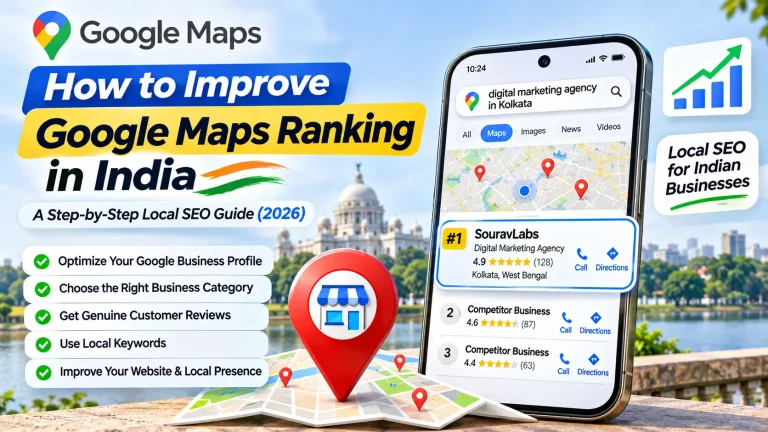
Local search visibility can come from traditional organic results and Google’s local results, including Google Maps.
7.1 Set Up Your Google Business Profile
Google Business Profile is a free tool that allows eligible businesses to manage their business information on Google Search and Maps.
Start by claiming and verifying your profile.
Then complete the important details:
- Business name.
- Correct business category.
- Address, where customers can visit.
- Service area, where applicable.
- Phone number.
- Website.
- Business hours.
- Services.
- Business description.
- Relevant photographs.
Keep the information accurate and updated.
For example, if your business operates from New Town, Kolkata, make sure your location and service information accurately reflect where you actually operate.
Don’t add fake locations to target additional areas.
7.2 Understand Google’s Local Ranking Factors
Google identifies three main factors behind local results.
Relevance: How closely your business matches what someone is searching for.
Distance: How far your business is from the searcher or the location used in the search.
Prominence: How well-known your business is, based on signals that can include reviews and links from other websites.
You cannot control every factor.
For example, you cannot force Google to show your business to someone searching from a distant location.
But you can improve the accuracy of your business information, strengthen your website and build a genuine reputation.
7.3 Collect Genuine Customer Reviews
Reviews help potential customers evaluate your business.
Ask satisfied customers to share honest feedback after completing a service or purchase.
You can send them your Google review link through WhatsApp or email.
Remember:
- Never purchase fake reviews.
- Don’t offer incentives in exchange for positive reviews.
- Don’t pressure customers to leave five-star ratings.
- Respond professionally to feedback.
- Address genuine complaints.
A thoughtful response to a negative review can demonstrate that your business takes customer satisfaction seriously.
7.4 Create Location-Specific Service Pages
Suppose your business provides website development in multiple areas.
Instead of creating one generic page, you might create useful location-specific pages where you genuinely serve those markets.
Each page should contain meaningful information about the service and location.
Avoid creating dozens of nearly identical pages by changing only the city name.
That approach creates little value for visitors.
7.5 Build Local Business Relationships
Local visibility is not limited to Google Business Profile.
You can also:
- Join relevant local business associations.
- Participate in genuine industry events.
- Collaborate with complementary businesses.
- Get listed in reputable local directories.
- Contribute useful information to local publications.
These activities can help people discover your business and may generate relevant website links.
8. Technical SEO: Fix the Problems That Prevent Visibility
Technical SEO can sound complicated, but small businesses usually need to focus on a manageable set of important issues.
8.1 Make Sure Your Website Is Mobile-Friendly
Many customers discover businesses using smartphones.
Your website should work properly on smaller screens.
Check whether:
- Text is readable.
- Buttons are easy to tap.
- Navigation works.
- Images fit the screen.
- Forms are easy to complete.
- Important contact information is visible.
A website that looks good on a desktop but becomes difficult to use on a mobile phone can lose potential enquiries.
8.2 Improve Website Speed
Website speed affects the visitor experience.
Imagine clicking a search result and waiting several seconds for the page to become usable.
Many visitors may leave before finding the information they need.
To improve performance:
- Compress images.
- Remove unnecessary plugins.
- Use reliable hosting.
- Enable appropriate caching.
- Minimise unnecessary scripts.
- Use a content delivery network where useful.
- Avoid loading unnecessary third-party resources.
Google’s Core Web Vitals provide useful performance measurements.
The recommended good thresholds are:
- LCP (loading): 2.5 seconds or less.
- INP (interactivity): 200 milliseconds or less.
- CLS (visual stability): 0.1 or less.
These are performance targets, not guaranteed ranking formulas.
8.3 Install an SSL Certificate
Your website should use HTTPS.
HTTPS helps protect information exchanged between a visitor’s browser and your website.
Most modern hosting providers offer SSL certificates.
Check that your website loads securely and that visitors are not redirected between inconsistent HTTP and HTTPS versions.
8.4 Submit an XML Sitemap
An XML sitemap helps search engines discover important website URLs.
Most modern SEO plugins for WordPress can generate one automatically.
For example, if you use Yoast SEO or Rank Math, check the sitemap settings.
You can then submit your sitemap through Google Search Console.
A sitemap helps discovery, but it does not guarantee indexing or higher rankings.
8.5 Check Indexing Issues
Sometimes important pages are not appearing in Google because they are blocked or have technical problems.
Use Google Search Console’s URL Inspection tool to investigate individual pages.
Check for:
- Accidental noindex tags.
- Robots.txt restrictions.
- Server errors.
- Incorrect canonical URLs.
- Redirect problems.
- Pages that Google has not indexed.
Fix genuine problems before spending money creating more content.
8.6 Use Structured Data Where Relevant
Structured data is additional information added to website code to help search engines understand certain types of content.
For example, a business may use appropriate LocalBusiness structured data to describe its business details.
A product page may use Product structured data.
A recipe page may use Recipe structured data.
Use the appropriate schema type and ensure the information accurately matches the visible page.
Structured data can make pages eligible for certain search features, but it does not guarantee rich results or higher rankings.
9. Content Marketing: Create Content That Attracts Potential Customers
Publishing useful content is one of the ways to expand your website’s search visibility.
However, there is an important difference between publishing content and creating content that supports business growth.
Suppose you run a small accounting firm.
Publishing an article about a random trending topic may bring visitors, but those visitors might never need accounting services.
Instead, consider topics such as:
- Accounting services for small businesses.
- Common GST filing mistakes.
- How to prepare financial records.
- Bookkeeping for startups.
- How to choose an accountant.
These topics are more closely connected to the business.
Build Topic Clusters
A topic cluster is a group of related content organised around a central subject.
For example:
Main topic: Small Business SEO
Supporting articles:
- How to Do Keyword Research.
- Local SEO for Small Businesses.
- On-Page SEO Checklist.
- Technical SEO Basics.
- How to Measure SEO Performance.
- Common SEO Mistakes.
Each supporting article can link to the main guide and other relevant resources.
This creates a more organised content structure.
Create Different Types of Content
Your content strategy should include different formats.
Educational articles: Answer common customer questions.
Comparison articles: Help customers compare products, tools or services.
How-to guides: Explain practical processes.
Case studies: Demonstrate genuine project experiences and measurable outcomes.
Service pages: Explain what your business offers and encourage relevant enquiries.
Don’t invent case studies or customer results. Use real project information and obtain permission where necessary.
For a deeper explanation of content planning and article length, read Best Content Length for SEO in India.
How Often Should a Small Business Publish Blogs?
There is no universal publishing frequency that guarantees rankings.
A small business might publish two genuinely useful articles every month.
Another business may publish one detailed article every month and achieve better results.
Prioritise usefulness, accuracy, originality and consistency over publishing volume.
10. Off-Page SEO and Link Building for Small Businesses
Your website does not exist in isolation.
Other websites, organisations and people can help your business gain visibility.
Link building is the process of earning links from other websites.
For small businesses, a practical approach is to build relationships rather than purchase large numbers of backlinks.
Practical Link-Building Strategies
1. Local Business Directories
Get listed in legitimate directories that are relevant to your location and industry.
2. Industry Partnerships
Collaborate with businesses that serve a similar audience without directly competing with you.
For example, a web development company might collaborate with a branding consultant.
3. Guest Contributions
Write genuinely useful articles for relevant industry websites where they accept external contributions.
Don’t publish low-quality articles merely to obtain links.
4. Local Media Coverage
Participate in meaningful community activities, business events or initiatives that may attract coverage from local publications.
5. Create Useful Resources
Publish original checklists, guides, calculators or research that other websites may naturally reference.
What Should You Avoid?
Avoid:
- Buying hundreds of backlinks.
- Automated link-building packages.
- Private blog networks.
- Spam comments.
- Irrelevant directory submissions.
- Excessive keyword-rich anchor text.
These shortcuts can create risks without delivering meaningful business value.
11. Best Free SEO Tools for Small Businesses in 2026
You don’t need to purchase several expensive SEO subscriptions when you’re starting.
Begin with free tools and understand how to use their information.
Google Search Console: Understand search visibility, indexing and organic search performance.
Google Analytics 4: Analyse website traffic, user behaviour and conversions.
Google Keyword Planner: Discover keyword ideas and estimated search demand.
Google Trends: Explore how search interest changes over time.
PageSpeed Insights: Check website performance and Core Web Vitals.
Google Business Profile: Manage eligible local business information on Google Search and Maps.
Bing Webmaster Tools: Review your website’s performance in Bing search.
Rich Results Test: Test structured data eligibility for supported search features.
Screaming Frog SEO Spider: Crawl websites and identify technical SEO issues. Its free version has usage limits.
My Recommended Starting Combination
If you’re a complete beginner, start with these five tools:
- Google Search Console.
- Google Analytics 4.
- Google Keyword Planner.
- Google Business Profile.
- PageSpeed Insights.
These tools cover many of the basic activities required for small business SEO.
You can consider paid platforms when you need more detailed competitor analysis, keyword research, backlink data or large-scale website audits.
12. How to Measure SEO Performance
One common mistake is evaluating SEO only through keyword rankings.
Rankings are important, but they don’t tell you whether your marketing is generating business.
Suppose your website receives 5,000 monthly visitors.
That might look impressive.
But if none of those visitors becomes a customer, you need to investigate whether you’re attracting the right audience.
Track the following metrics.
Organic Clicks
How many people visit your website through unpaid search results?
Use Google Search Console to understand organic clicks.
Impressions
How often your website appears in Google search results.
Increasing impressions can indicate growing visibility, although impressions alone don’t guarantee meaningful traffic.
Click-Through Rate
CTR is the percentage of impressions that result in clicks.
For example, if a page receives 1,000 impressions and 50 clicks, its CTR is 5%.
You can improve your search presentation through more relevant titles and descriptions, but Google ultimately determines what appears in search results.
Keyword Positions
Track important search queries and observe how their visibility changes over time.
Avoid obsessing over one ranking position because results can vary by location, device and search context.
Organic Enquiries
This is one of the most important business metrics.
Track:
- Contact form submissions.
- Phone calls.
- WhatsApp enquiries.
- Appointment bookings.
- Quote requests.
- Purchases.
Use appropriate analytics events, call tracking or CRM records to connect marketing activity with enquiries.
Conversion Rate
Conversion rate measures the percentage of visitors who complete a desired action.
For example:
If 500 relevant visitors generate 10 enquiries, the enquiry conversion rate is 2%.
This helps you understand whether your website is converting traffic effectively.
13. How Much Does SEO Cost for a Small Business?
SEO costs vary significantly depending on the industry, competition, location, website condition and amount of work required.
There is no single price that applies to every business.
Your options generally fall into three categories.
Option 1: Do SEO Yourself
You can learn and implement basic SEO independently.
Your main investment will be time.
This approach is suitable when:
- Your website is small.
- Your competition is manageable.
- You have time to learn.
- Your technical requirements are limited.
However, you should understand that DIY SEO still requires regular work.
Option 2: Hire a Freelancer
A freelancer can help with specific activities such as:
- Keyword research.
- On-page optimisation.
- Technical audits.
- Content optimisation.
- Local SEO.
This can be useful when you need specialist support without hiring a full agency.
Option 3: Hire an SEO Agency
An SEO agency may provide a broader range of services.
These can include:
- SEO strategy.
- Technical SEO.
- Content planning.
- Local SEO.
- Link acquisition.
- Performance reporting.
- Conversion optimisation.
Before hiring an agency, understand exactly what is included in the monthly service.
Ask questions such as:
- What activities will you perform?
- How will you select keywords?
- How will you measure success?
- Will I own the website and its accounts?
- How frequently will I receive reports?
- How will you connect SEO performance with business enquiries?
Be careful of guaranteed first-page rankings or unrealistic traffic promises.
No agency can honestly guarantee a specific Google ranking.
14. How Long Does SEO Take to Show Results?
SEO requires patience.
It is not an advertising campaign where you can expect traffic immediately after activating it.
The timeline depends on several factors:
- Website age and history.
- Competition.
- Industry.
- Website quality.
- Existing search visibility.
- Content quality.
- Technical issues.
- Location.
- Consistency of implementation.
A new website in a competitive industry may require considerable time to build visibility.
A local business with an established website and a few technical issues may notice improvements sooner after correcting them.
Think about SEO as a continuous improvement process.
Instead of asking, “When will I reach number one?”, ask:
- Are more relevant pages being indexed?
- Are search impressions increasing?
- Are important queries generating clicks?
- Are visitors exploring relevant pages?
- Are enquiries improving?
- Are we attracting more qualified customers?
These questions provide a more realistic picture of progress.
15. Common SEO Mistakes Small Businesses Should Avoid
Even businesses that invest in SEO sometimes make avoidable mistakes.
Here are some of the most important ones.
Mistake 1: Targeting Keywords Without Understanding Intent
A keyword may have substantial search demand but little commercial relevance.
Always understand why someone is searching before creating a page.
Mistake 2: Using the Same Keyword Everywhere
Repeating a keyword unnaturally does not make a page better.
Write naturally and cover the topic properly.
Mistake 3: Publishing Thin Content
A short article with little useful information may not satisfy the reader.
Don’t focus on publishing more pages than your competitors.
Focus on answering questions better.
Mistake 4: Ignoring Local SEO
If your customers are nearby, ignoring your Google Business Profile and local search visibility can mean missing valuable opportunities.
Mistake 5: Neglecting Mobile Users
A difficult mobile experience can affect both usability and conversions.
Always test your website on real mobile devices.
Mistake 6: Buying Backlinks
Unnatural link-building tactics can create search policy risks.
Build genuine relationships and earn relevant mentions.
Mistake 7: Ignoring Website Conversions
Getting visitors is only part of the job.
Your website should make it easy to call, enquire, book or purchase.
Mistake 8: Expecting Instant Results
SEO is a long-term investment.
Changing your title today doesn’t mean your website will immediately rank first tomorrow.
Mistake 9: Publishing AI-Generated Content Without Reviewing It
AI tools can help with research, outlining and drafting.
But publishing large amounts of unreviewed, repetitive or inaccurate content is not a sustainable SEO strategy.
Check facts, add useful examples, demonstrate real expertise and make sure every page provides value.
Mistake 10: Measuring Success Only Through Traffic
A smaller number of relevant visitors may generate more business than a large amount of irrelevant traffic.
Track enquiries and sales alongside search performance.
16. SEO in 2026: What About AI Search?
Search behaviour is evolving.
People increasingly discover information through traditional search engines as well as AI-powered search experiences.
Tools such as ChatGPT, Gemini and Perplexity have introduced additional ways for people to research businesses, compare solutions and understand products.
This has encouraged discussions around Generative Engine Optimisation (GEO) and Answer Engine Optimisation (AEO).
These terms generally describe efforts to make useful information easier for AI-powered systems and answer experiences to understand, reference and present.
Does this mean traditional SEO is no longer important?
No.
Your business still needs:
- Accessible website pages.
- Accurate information.
- Useful and original content.
- Clear service descriptions.
- A trustworthy online presence.
- Relevant mentions and references.
- A good user experience.
How Can Small Businesses Prepare?
1. Answer Specific Questions Clearly
Create content that addresses real customer questions.
For example, instead of writing a generic article about website development, explain how much a small business website may cost, what affects the price and what a business should prepare before starting.
2. Demonstrate Real Expertise
Include practical explanations, genuine project examples, original observations and accurate information.
3. Maintain Consistent Business Information
Make sure your website and legitimate business profiles communicate accurate information about your services.
4. Use Clear Website Structures
Organise content into logical categories and connect related pages through internal links.
5. Don’t Chase Every New AI Trend
Avoid paying for services that promise guaranteed AI citations or visibility without explaining their actual methodology.
AI search is an evolving area. No one can guarantee that a business will appear in every AI-generated answer.
The practical approach is to build a useful, credible online presence that serves customers regardless of where they discover your business.
17. Your 90-Day SEO Action Plan
Understanding SEO is useful, but implementation is what makes the difference.
If you’re a small business owner, you don’t need to complete every SEO activity immediately.
Start with a manageable plan.
Days 1–15: Build the Foundation
Focus on understanding your website and setting up measurement.
Tasks:
- Set up Google Search Console.
- Set up Google Analytics 4.
- Check whether important pages are indexed.
- Review website navigation.
- Check mobile usability.
- Test website performance.
- Identify broken pages and links.
- Make sure HTTPS is working.
- Review your existing website content.
Your goal: Understand your website’s current condition before making major changes.
Days 16–30: Complete Keyword Research
Now identify the searches that matter to your business.
Tasks:
- List all products and services.
- Identify your target customers.
- Research relevant keywords.
- Understand search intent.
- Review competing websites.
- Identify keyword opportunities.
- Assign keyword groups to existing or planned pages.
Your goal: Build a clear keyword-to-page strategy.
Days 31–45: Optimise Important Pages
Start with the pages most likely to generate customers.
Tasks:
- Improve the homepage.
- Optimise important service pages.
- Write descriptive title tags.
- Improve meta descriptions.
- Organise headings.
- Add relevant internal links.
- Improve images.
- Make contact information visible.
- Add clear calls to action.
Your goal: Make important website pages more relevant and useful.
Days 46–60: Improve Local SEO and Technical SEO
Focus on local visibility and website accessibility.
Tasks:
- Claim and verify your Google Business Profile.
- Complete accurate business information.
- Add relevant photographs.
- Review your business categories.
- Ask genuine customers for feedback.
- Respond to existing reviews.
- Check sitemap configuration.
- Investigate indexing problems.
- Fix important mobile and speed issues.
Your goal: Strengthen your business’s local visibility and technical foundation.
Days 61–75: Build Useful Content and Authority
Start expanding your website’s topical coverage.
Tasks:
- Publish two or three useful articles, depending on available resources.
- Answer common customer questions.
- Link articles to relevant service pages.
- Update outdated content.
- Identify relevant local directories.
- Explore genuine business partnerships.
- Look for relevant publishing opportunities.
Your goal: Make your website a more useful resource for potential customers.
Days 76–90: Measure and Improve
Now review the results of your work.
Tasks:
- Check Google Search Console.
- Compare organic clicks and impressions.
- Review important search queries.
- Identify pages receiving impressions but few clicks.
- Review website enquiries.
- Check Google Business Profile performance.
- Identify pages that need improvement.
- Prepare the next 90-day content plan.
Your goal: Understand what is working and decide what deserves more attention.
Remember that 90 days is an implementation roadmap, not a ranking guarantee. Search performance may take longer to improve.
18. Small Business SEO Checklist
Use the following list to review the most important areas of your SEO strategy.
Website Foundation
- Google Search Console is configured.
- Google Analytics 4 is configured.
- Website uses HTTPS.
- Important pages are accessible.
- Website works properly on mobile.
- Broken links and important errors are addressed.
- XML sitemap is configured where appropriate.
Keyword Research
- Main products and services are identified.
- Customer search terms are researched.
- Search intent is understood.
- Keywords are mapped to relevant pages.
- Local keywords are considered where relevant.
On-Page SEO
- Important pages have descriptive titles.
- Meta descriptions are relevant.
- Headings are organised properly.
- Content answers customer questions.
- Images are optimised.
- Internal links connect relevant pages.
- URLs are descriptive.
Local SEO
- Google Business Profile is claimed and verified.
- Business information is accurate.
- Business categories are appropriate.
- Services and operating hours are updated.
- Genuine reviews are encouraged.
- Customer feedback receives professional responses.
- Location pages provide useful information where necessary.
Content and Authority
- A practical content plan exists.
- Articles address genuine customer questions.
- Important articles link to relevant service pages.
- Outdated content is reviewed.
- Relevant business relationships are developed.
- Backlinks are earned through legitimate activities.
Performance Measurement
- Organic clicks are monitored.
- Search impressions are reviewed.
- Important queries are tracked.
- Website enquiries are measured.
- Conversion performance is reviewed.
- SEO priorities are updated regularly.
19. Should You Do SEO Yourself or Hire an SEO Agency?
This depends on your business requirements, available time and competition.
Doing SEO yourself can be a good starting point if you have a small website and are willing to learn.
You can manage keyword research, basic content optimisation, Google Business Profile and simple performance monitoring independently.
However, professional assistance may become useful when:
- Your industry has strong competition.
- Your website has complex technical problems.
- You need a complete SEO strategy.
- You have multiple locations.
- You need regular content production.
- You cannot manage SEO consistently.
- You want to connect SEO with your wider marketing and sales activities.
The important thing is to understand what you’re paying for.
A good SEO partner should explain the strategy, activities, priorities and measurement process in understandable language.
You should never feel that SEO is a mysterious service where you pay a monthly fee without knowing what is happening.
If you want professional support with keyword research, technical SEO, local SEO, on-page optimisation and content strategy, explore SouravLabs SEO Services.
Frequently Asked Questions About SEO for Small Business
1. What Is SEO for Small Business?
SEO for small business is the process of improving a small company’s website and online presence so potential customers can discover its products or services through unpaid search results. It includes keyword research, on-page SEO, technical SEO, local SEO, content creation and link building.
2. Can a Small Business Do SEO Without Hiring an Agency?
Yes. Small businesses can perform many basic SEO activities independently. They can use free tools such as Google Search Console, Google Analytics 4, Google Keyword Planner and Google Business Profile. However, complex technical SEO and highly competitive markets may require professional support.
3. How Much Does SEO Cost for a Small Business?
SEO costs depend on the website, industry, competition, location and scope of work. Businesses can manage basic SEO themselves, hire freelancers for specific tasks or work with an SEO agency for ongoing strategy and implementation. There is no universal SEO price for every small business.
4. How Long Does SEO Take to Work?
SEO timelines vary depending on competition, website history, technical condition, content quality and consistency. Some improvements may become visible earlier than others, but meaningful organic growth often requires sustained effort over several months. There is no guaranteed ranking timeline.
5. What Is the Most Important Part of SEO for a Small Business?
There is no single activity that works for every business. However, understanding customer search intent, creating relevant service pages, resolving important technical problems and improving local visibility are strong starting priorities for many small businesses.
6. Is Local SEO Important for Small Businesses?
Yes, particularly for businesses that serve customers in specific geographical areas. Local SEO helps businesses become discoverable through location-based searches and Google Maps. A complete Google Business Profile, accurate business information, genuine reviews and relevant website content can support local visibility.
7. Which Free SEO Tools Should Beginners Use?
Beginners can start with Google Search Console, Google Analytics 4, Google Keyword Planner, Google Trends, Google Business Profile and PageSpeed Insights. These tools help with keyword discovery, website performance, search visibility and local business management.
8. Is Blogging Necessary for Small Business SEO?
Blogging is not compulsory for every business, but useful articles can attract people searching for information related to your products or services. A good content strategy answers customer questions and supports your main service pages rather than publishing articles simply to increase website traffic.
9. Are Backlinks Still Important for SEO in 2026?
Relevant backlinks remain an important part of building a website’s reputation and discoverability. Small businesses should focus on earning links through genuine partnerships, industry contributions, useful resources and legitimate local business relationships rather than purchasing large numbers of links.
10. Can AI-Generated Content Rank on Google?
Content created with AI assistance can appear in search results when it provides genuine value and follows applicable search policies. However, automatically publishing large amounts of repetitive, inaccurate or unhelpful content is not a sustainable SEO strategy. Human review, accuracy, originality and usefulness remain important.
11. Is SEO Better Than Google Ads for a Small Business?
Neither channel is universally better. Google Ads can provide visibility through paid campaigns, while SEO focuses on organic visibility. Businesses with immediate lead requirements may benefit from advertising, whereas SEO can support longer-term organic customer acquisition. The right choice depends on budget, competition and business objectives.
12. How Can I Check Whether My Website Is Performing Well in SEO?
Use Google Search Console to review clicks, impressions, search queries and indexing. Use Google Analytics 4 to understand website traffic and user behaviour. Also monitor enquiries, calls, form submissions and sales to determine whether organic visitors are generating business value.
Conclusion
SEO for small business doesn’t need to be complicated or unnecessarily expensive.
You don’t need to implement every advanced SEO technique, purchase multiple premium tools or publish hundreds of articles to get started.
What you need is a clear understanding of your customers, the searches they make and the information they need before choosing a business.
Start with the fundamentals.
Understand your target keywords. Improve your important service pages. Make your website technically accessible. Optimise your Google Business Profile if you serve local customers. Publish useful content and build genuine business relationships.
Most importantly, measure the results.
Don’t judge your SEO strategy only by keyword rankings or website traffic. Pay attention to qualified visitors, enquiries, calls and actual business opportunities.
SEO is not a one-time activity. It is an ongoing process of understanding your audience, improving your website and building your online reputation.
If you’re a small business owner starting SEO in 2026, don’t try to do everything at once.
Start with your most important pages, follow the 90-day roadmap and improve your strategy as you learn from the results.
Small, consistent improvements can build a stronger foundation for long-term organic growth.
Want to Improve Your Small Business’s Visibility on Google?
Understanding SEO is the first step. Implementing the right strategy consistently is what helps turn search visibility into business opportunities.
If your business needs help with keyword research, technical SEO, on-page optimisation, local SEO or a complete SEO strategy, SouravLabs can help you identify opportunities and build a practical approach around your business goals.
Explore our SEO Services to understand how we approach search visibility and organic growth.
You can also visit SouravLabs to explore our digital marketing solutions.
SouravLabs
Website: https://souravlabs.com
Email: contact@souravlabs.com