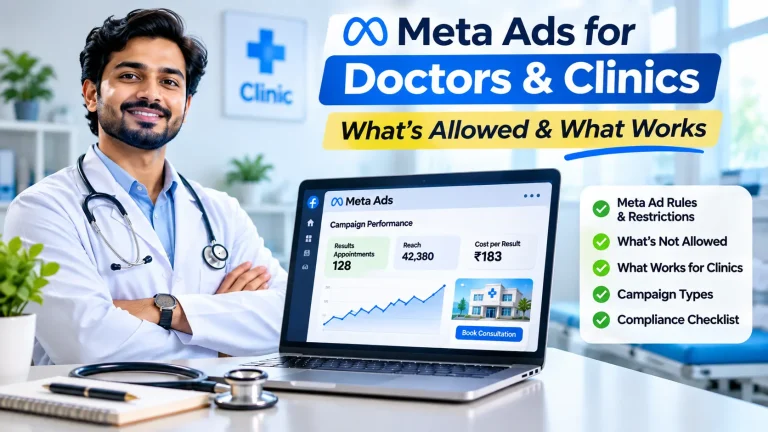

Imagine you own a local clothing store, a coaching centre, a restaurant or a small service-based business.
You have created a Facebook page and an Instagram account. You regularly post pictures, videos and offers. Sometimes people like your posts, but very few actually contact you or become customers.
You start wondering: How are other businesses reaching hundreds or thousands of potential customers through Facebook and Instagram?
The answer, in many cases, is Meta Ads.
Meta advertising allows businesses to show advertisements to selected audiences across platforms such as Facebook, Instagram, Messenger and other eligible placements. Instead of waiting for people to discover your business organically, you can actively reach people who may be interested in your products or services.
But there is one important thing beginners should understand.
Running Meta Ads is not the same as simply boosting a Facebook or Instagram post.
You can spend money promoting attractive content and still generate no meaningful business. The difference between a successful advertising campaign and a wasted budget often comes down to your objective, audience, offer, advertisement and follow-up process.
In this guide, we will explain Meta Ads for Small Business from the beginning. You will learn how the platform works, which campaign objectives to choose, how much to spend, how to find the right audience and how to measure actual business results.
Whether you run a local business, an online store, a professional service or a startup, this guide will help you understand how to approach Meta advertising practically in 2026.
1. What Are Meta Ads?
Meta Ads are paid advertisements that businesses create through Meta’s advertising platform.
Meta is the parent company of several popular digital platforms, including:
-
Facebook
-
Instagram
-
Messenger
-
WhatsApp (through supported advertising experiences)
-
Meta Audience Network
Businesses can use Meta’s advertising tools to promote products, services, websites, offers, events and other business activities.
For example:
Suppose you own a dental clinic in Kolkata.
You want more people from nearby areas to discover your clinic and book appointments.
You can create an advertisement showing your clinic, introducing your services and encouraging interested people to contact you through WhatsApp or another available contact method.
You can configure the campaign to reach people in relevant locations and optimize delivery towards an appropriate action.
Similarly:
| Business | Possible advertising goal |
|---|---|
| Clothing store | Generate online purchases |
| Restaurant | Receive enquiries and orders |
| Coaching centre | Generate admission enquiries |
| Real estate business | Generate property enquiries |
| Digital marketing agency | Generate qualified leads |
| Beauty salon | Receive appointment enquiries |
| E-commerce store | Increase product sales |
| Local service provider | Receive customer calls or messages |
The biggest advantage is that you do not necessarily need a huge marketing budget to start.
A small business can begin with a controlled budget, test different advertisements and gradually increase spending when the campaign produces profitable results.
However, advertising costs money, and results are never guaranteed.
2. Why Should Small Businesses Use Meta Ads in 2026?
Small businesses often have three major marketing challenges:
-
Limited marketing budgets.
-
Difficulty reaching new customers.
-
Inconsistent enquiries and sales.
Meta Ads can help address these problems when the campaign is properly planned.
Let’s understand the benefits.
2.1 Reach Potential Customers Beyond Your Existing Followers
Organic social media marketing mainly depends on people discovering and engaging with your content without paid distribution.
The problem is that your followers represent only a portion of your potential market.
Imagine you have 800 Instagram followers but your business serves 20,000 potential customers in your city.
Advertising allows you to reach relevant people who do not already follow your account.
You can introduce your business to new audiences rather than depending entirely on existing followers.
2.2 Target Customers Based on Location
Location targeting is particularly useful for local businesses.
Suppose you operate a gym in Siliguri.
You probably do not need to advertise your gym to someone living in Chennai.
You can focus your campaign on relevant geographical areas around your business.
Depending on the available targeting settings, you may also refine your audience using other permitted criteria.
Remember that geographical targeting is not a guarantee that every person reached will be a genuine potential customer. People may travel, work or have other connections to an area.
2.3 Generate Leads and Enquiries
Not every business sells products directly through a website.
Many small businesses depend on conversations before customers make purchasing decisions.
Examples include:
-
Real estate consultations.
-
Coaching admissions.
-
Interior design projects.
-
Digital marketing services.
-
Wedding photography.
-
Healthcare appointments.
-
Business consulting.
Meta Ads can help these businesses generate enquiries through supported instant forms, messaging destinations or website forms.
The business can then contact interested people and guide them through the sales process.
2.4 Test Marketing Ideas Quickly
Traditional advertising can make it difficult for a small business to test different messages.
With Meta Ads, you can experiment with:
-
Different images.
-
Short videos.
-
Different offers.
-
Multiple headlines.
-
Different customer segments.
-
Alternative calls to action.
For example, a clothing store could test two advertisements:
Advertisement A: New festive collection available.
Advertisement B: Upgrade your festive wardrobe with our latest collection.
Both advertisements promote the same products, but the messaging is different.
The campaign results can help you understand which message attracts more meaningful interest.
2.5 Build Brand Awareness
Not every customer purchases immediately after seeing an advertisement.
Someone may discover your business today, visit your Instagram profile tomorrow and contact you next week.
Repeated exposure to relevant advertisements can help customers become familiar with your business.
This is especially useful for businesses with longer buying journeys.
However, brand awareness should not be confused with sales. Measure awareness campaigns using suitable awareness metrics rather than expecting every impression to produce an immediate purchase.
3. How Do Meta Ads Work?
Before creating your first campaign, you should understand the basic structure of Meta advertising.
Meta Ads Manager generally organizes campaigns into three main levels.

Level 1: Campaign
The campaign represents your primary advertising objective.
You decide what you want to achieve.
For example:
-
Generate leads.
-
Increase sales.
-
Get more website traffic.
-
Improve brand awareness.
-
Encourage engagement.
Think of the campaign as the overall destination of your advertising activity.
Level 2: Ad Set
The ad set contains important delivery and audience settings.
Depending on your campaign setup, these can include:
-
Audience targeting.
-
Location.
-
Budget and schedule.
-
Placements.
-
Optimization and performance goals.
-
Conversion location.
Think of the ad set as the plan for reaching people and generating the desired action.
Level 3: Ad
The ad is what your potential customers actually see.
It includes elements such as:
-
Image or video.
-
Primary text.
-
Headline.
-
Description, where available.
-
Call-to-action button.
-
Destination, such as a website or messaging experience.
Think of the ad as the message you present to your potential customer.
A Simple Example
Suppose you run a coaching centre.
Your advertising structure might look like this:
| Level | Example |
|---|---|
| Campaign | Generate admission enquiries |
| Ad set | Students and parents in selected local areas |
| Ad | Video introducing courses and admission information |
You can create multiple advertisements within an ad set to test different creative approaches.
You can also create additional ad sets when you have a genuine reason to test different audiences, locations or delivery strategies.
Important: Do not create dozens of campaigns and ad sets when you are starting. A simple, organized account is easier to manage and evaluate.
4. Meta Ads Campaign Objectives: Which One Should You Choose?
Choosing the correct campaign objective is one of the most important decisions when running Meta Ads.
Your objective tells Meta what type of result you want to achieve.
For example, if your goal is to generate customer enquiries, selecting an objective designed for website traffic may not be the best starting point.
Meta’s current advertising framework uses six main campaign objectives.

Let’s understand each one.
4.1 Awareness
The Awareness objective is designed to help businesses increase exposure and visibility.
You can use it when:
-
Launching a new business.
-
Introducing a new product.
-
Promoting a local brand.
-
Increasing brand recognition.
-
Reaching a broader relevant audience.
Example: A new restaurant wants people in its service area to discover its brand before its opening.
An awareness campaign can help introduce the restaurant to potential customers.
Do not judge this campaign only by the number of sales. Its purpose is primarily visibility.
4.2 Traffic
The Traffic objective is designed to send people to a destination.
That destination might include:
-
A website.
-
A landing page.
-
An app.
-
Another supported destination.
Example: An online furniture business wants potential customers to visit a page containing its latest collection.
Traffic campaigns can help attract visitors.
However, remember that website visits do not automatically mean purchases.
Someone can click an advertisement, visit your website for five seconds and leave without doing anything.
If your real objective is sales and you have the required tracking and setup, consider a suitable Sales campaign rather than assuming that more traffic will solve the problem.
4.3 Engagement
The Engagement objective helps businesses encourage interactions with their content or supported communication destinations.
Depending on the available setup, this can include:
-
Post engagement.
-
Video views.
-
Messaging conversations.
-
Other supported engagement actions.
Example: A beauty salon wants to promote a new service and encourage potential customers to start conversations.
An engagement campaign may be suitable if the selected performance goal matches the intended result.
But remember:
More likes do not necessarily mean more customers.
4.4 Leads
The Leads objective is particularly useful for service-based and local businesses.
It helps businesses collect potential customer information or generate enquiries through supported destinations.
Possible lead generation methods include:
-
Instant forms.
-
Website forms.
-
Messaging.
-
Calls, where supported.
Example: A coaching institute wants enquiries from students interested in its upcoming admission programme.
The advertisement can introduce the course and encourage interested people to submit an enquiry form.
A lead campaign can be useful when your business needs conversations before making a sale.
However, lead quantity and lead quality are different things.
Getting 100 enquiries from people who cannot afford your service may be less valuable than getting 15 enquiries from genuinely interested customers.
4.5 App Promotion
The App Promotion objective is designed for businesses that want to encourage app installations or app-related actions.
It may be relevant for:
-
Shopping applications.
-
Food delivery applications.
-
Financial applications.
-
Educational applications.
-
Subscription-based applications.
Example: A startup has developed a learning application and wants to attract new users.
It can use an appropriate app promotion campaign to encourage installations or other supported in-app actions.
4.6 Sales
The Sales objective is designed to help businesses generate purchases or other valuable conversion actions.
It can be useful for:
-
E-commerce businesses.
-
Online retailers.
-
Product brands.
-
Businesses selling through supported messaging experiences.
-
Other businesses with suitable conversion destinations.
Example: An online clothing store wants customers to purchase products directly from its website.
With appropriate tracking and conversion configuration, a Sales campaign can help Meta optimize delivery towards people more likely to complete purchases.
Which Objective Is Best for Your Business?
| Business requirement | Objective to consider |
|---|---|
| Introduce a new brand | Awareness |
| Bring visitors to a website | Traffic |
| Encourage social interactions | Engagement |
| Generate customer enquiries | Leads |
| Promote a mobile application | App Promotion |
| Generate product purchases | Sales |
There is no universally best campaign objective.
The right choice depends on what your business actually wants customers to do.
My recommendation for beginners is simple: identify the business result first, then select the campaign objective that most closely supports it.
5. What Do You Need Before Running Meta Ads?
Many beginners immediately open Ads Manager and start creating advertisements.
That is not the best approach.
Prepare the basic business infrastructure first.
5.1 A Facebook Business Page
You should have a professional Facebook business Page.
It should include:
-
Business name.
-
Profile picture or logo.
-
Cover image.
-
Business description.
-
Contact details.
-
Website, if available.
-
Relevant business information.
Your Page should look trustworthy.
Imagine someone sees your advertisement and visits your Facebook Page. If the Page has no business information, outdated content or confusing contact details, that person may hesitate to contact you.
5.2 An Instagram Professional Account
If Instagram is relevant to your audience, create or connect an appropriate professional Instagram account.
Use:
-
A recognizable profile picture.
-
A clear business description.
-
Relevant contact information.
-
Useful posts and Reels.
-
Consistent branding.
You do not need thousands of followers before advertising.
However, having a credible profile gives interested people more confidence.
5.3 Meta Business Portfolio and Ads Manager
Meta provides business management tools that help businesses manage their assets and advertising activities.
You should understand the purpose of:
-
Meta Business Portfolio.
-
Facebook Page.
-
Instagram account.
-
Ad account.
-
Payment method.
-
People and access permissions.
-
Meta Ads Manager.
Ads Manager is the main tool for creating, managing and analyzing advertising campaigns.
You can access it through:
Make sure you use your own business assets and provide access to employees or agencies through appropriate permissions.
Avoid sharing personal passwords.
5.4 A Clear Offer
An advertisement needs something meaningful to communicate.
Simply saying “We provide the best service” is rarely enough.
Your offer should answer:
-
What are you selling?
-
Who is it for?
-
What problem does it solve?
-
Why should someone choose your business?
-
What should the customer do next?
For example:
Weak offer:
“We provide digital marketing services.”
Better offer:
“Need more customer enquiries for your local business? Explore our digital marketing solutions for lead generation.”
The second message communicates a customer problem and a relevant solution.
5.5 A Landing Page or Communication Channel
Where should people go after clicking your advertisement?
Depending on your business, it could be:
-
A website landing page.
-
A product page.
-
A WhatsApp conversation.
-
An instant lead form.
-
A booking page.
-
A phone call destination.
Make sure the destination works properly before launching the campaign.
An advertisement cannot compensate for a broken website or an unanswered WhatsApp message.
6. How to Create Your First Meta Ads Campaign: Step-by-Step
Now let’s understand how to create a basic campaign.
For this example, imagine you run a local service business and want to generate customer enquiries.

Step 1: Open Meta Ads Manager
Visit Meta Ads Manager and select the appropriate advertising account.
Check that you have selected the correct account before creating your campaign.
If you manage multiple businesses, this step is especially important.
Step 2: Click Create
Select the option to create a new campaign.
Meta will ask you to choose a campaign objective.
For our example, select Leads.
Step 3: Configure Your Campaign
Give the campaign a meaningful name.
For example:
Local Business - Lead Generation - November 2026
A good naming structure makes it easier to identify campaigns later.
Review the available campaign settings and select an appropriate budget strategy.
Some campaign setups offer campaign-level budget options, while others allow budgets at the ad set level.
Choose the structure that suits your testing plan.
Step 4: Configure Your Ad Set
Now you need to decide how Meta should deliver your advertisements.
Consider the following:
Conversion location: Select the appropriate destination for your leads, such as an instant form, website or supported messaging option.
Performance goal: Select the option that aligns with the type of lead or action you want.
Audience: Choose your relevant geographical area and any suitable audience settings.
Budget: Set a realistic amount.
Schedule: Decide when your campaign should start and whether it should run continuously or for a defined period.
The exact options available may vary depending on the objective, account, country and campaign configuration.
Step 5: Create Your Advertisement
This is where you create the actual advertisement.
Prepare:
-
A clear image or video.
-
Primary text.
-
Headline.
-
Call-to-action.
-
Destination.
For example:
Primary text:
“Looking for professional digital marketing support for your business?
Get practical solutions for Facebook and Instagram advertising, lead generation and online growth.
Contact us to discuss your business requirements.”
Headline:
“Grow Your Business Online”
CTA:
Use an appropriate available action, such as Contact Us or Learn More.
Make sure the advertisement communicates a real offer and does not make misleading promises.
Step 6: Review Everything
Before publishing, check:
-
Campaign objective.
-
Budget.
-
Audience.
-
Location.
-
Ad creative.
-
Destination URL or contact method.
-
Payment method.
-
Advertising policies.
Preview your advertisement across the relevant placements.
Check how the image or video appears on mobile devices.
Step 7: Publish Your Campaign
After reviewing the campaign, publish it.
Meta will review the advertisement before it can begin delivering.
Approval is not guaranteed, and the review process may take time.
Once the campaign is active, monitor its performance instead of making random changes every few hours.
7. Meta Ads Targeting: How to Reach the Right Customers
Targeting is one of the most discussed parts of Meta advertising.
But beginners often make one major mistake: they assume that narrower targeting always produces better results.
That is not necessarily true.
Meta’s advertising system uses audience signals, campaign settings and delivery optimization to determine which people should receive advertisements.
In 2026, automated audience and delivery features are an important part of the platform.
You should understand the main audience types before deciding how to structure your campaign.
7.1 Location Targeting
This is particularly important for businesses that serve a limited geographical area.
For example:
-
A salon may target relevant areas around its location.
-
A restaurant may focus on people within its delivery or service area.
-
A coaching centre may target relevant nearby towns.
-
A local contractor may advertise within selected districts.
Do not automatically select an entire state or country if your business cannot serve those locations.
Start with the area where you can realistically deliver your product or service.
7.2 Demographic Targeting
Depending on the campaign and available settings, you may be able to use demographic signals such as age ranges and other permitted audience characteristics.
For example, a children’s educational programme may have a different intended audience from a retirement planning service.
However, targeting options are subject to Meta’s restrictions and special advertising rules.
Some categories, such as housing, employment and financial products, may have additional requirements.
7.3 Interest-Based Targeting
Interest-based targeting allows advertisers to use available interest and behaviour-related audience signals.
For example:
A business selling fitness equipment may explore relevant fitness-related audience options.
A photography business may explore available photography-related interests.
But do not assume that every interest is available in every account or that an interest guarantees purchase intent.
7.4 Custom Audiences
Custom Audiences help businesses reach people who have already interacted with their business or whose information they are permitted to use.
Depending on eligibility and available data sources, these audiences may include:
-
Existing customers.
-
Website visitors.
-
People who engaged with Facebook or Instagram content.
-
Customer lists.
-
Other supported engagement sources.
For example, someone visits your website, views a product and leaves without purchasing.
You may be able to use an eligible audience source to reach relevant website visitors again.
This is commonly called remarketing or retargeting.
Always follow applicable privacy laws, consent requirements and Meta’s data policies when using customer information.
7.5 Lookalike Audiences
Lookalike Audiences can help advertisers find people who share characteristics with an eligible source audience.
For example, an e-commerce business may use a suitable customer source to help find additional potential customers.
The quality of the source matters.
A list containing genuine purchasers is generally more useful than a list containing random enquiries that never became customers.
7.6 Advantage+ Audience and Automation
Meta offers Advantage+ features that use automation to support audience and campaign delivery.
Depending on the campaign, these tools may help the system explore opportunities beyond certain audience suggestions.
For beginners, it is worth testing appropriate automated settings rather than assuming that manually selecting dozens of interests will always perform better.
However, automation does not eliminate the need for good business strategy.
You still need to define:
-
Your ideal customer.
-
Your service area.
-
Your offer.
-
Your conversion goal.
-
Your budget.
-
Your creative message.
Practical recommendation: Start with a clearly defined business audience and reasonable geographical boundaries. Use available automation where appropriate, and evaluate results based on actual customer quality.
8. Meta Ads Budget for Small Business: How Much Should You Spend?
One of the first questions business owners ask is:
“How much money do I need to run Facebook and Instagram advertisements?”
There is no fixed amount.
Your advertising budget depends on:
-
Your industry.
-
Competition.
-
Target location.
-
Product or service price.
-
Customer acquisition cost.
-
Campaign objective.
-
Conversion rate.
-
Quality of your advertisement.
A local business may start with a relatively small daily budget, while an e-commerce business targeting multiple regions may require a larger testing budget.
A Practical Starting Budget
Here is an illustrative starting framework for a small business in India.
| Budget level | Daily budget | Approx. 30-day spend |
|---|---|---|
| Small test | ₹200 | ₹6,000 |
| Basic testing | ₹300 | ₹9,000 |
| Moderate testing | ₹500 | ₹15,000 |
| Larger testing | ₹1,000 | ₹30,000 |
These are suggested planning examples, not Meta’s minimum requirements or guaranteed performance benchmarks. Actual results and applicable taxes can vary.
How Should You Allocate Your Budget?
Suppose you have ₹9,000 available for a 30-day campaign.
You could begin with:
-
₹300 per day.
-
One clearly defined campaign.
-
One or two genuinely different creative approaches.
-
A relevant audience and conversion destination.
-
Regular performance monitoring.
Avoid splitting a small budget across too many campaigns and ad sets.
Why?
Because each separate campaign or ad set may receive too little data to help you make meaningful decisions.
Understand Cost Per Lead
Suppose you spend ₹3,000 on advertising and receive 30 enquiries.
Your cost per lead is:
Your cost per lead is ₹100.
But is that good?
You cannot answer this question without considering how many enquiries become paying customers and how much profit each customer generates.
Understand the Real Cost of Customer Acquisition
Let’s continue the example.
| Metric | Result |
|---|---|
| Advertising spend | ₹3,000 |
| Total leads | 30 |
| Qualified leads | 15 |
| Paying customers | 3 |
| Revenue per customer | ₹2,000 |
| Total revenue | ₹6,000 |
Your advertising cost per customer is:
Your revenue from advertising-generated customers is ₹6,000.
However, revenue is not profit.
You must also consider product costs, delivery, employee expenses, discounts, taxes and other operating costs.
This is why successful Meta advertising should be measured using business economics, not just cheap leads.
When Should You Increase Your Budget?
Consider increasing your advertising budget when:
-
Your campaign consistently generates relevant enquiries or sales.
-
Your customer acquisition cost is sustainable.
-
Your business can handle additional demand.
-
Your sales team can follow up properly.
-
You have enough evidence to justify further investment.
Do not double your budget simply because you received several enquiries yesterday.
Look for a consistent pattern.
9. How to Create Meta Ads That Actually Attract Customers
Your advertisement is often the first interaction someone has with your business.
You may have a perfect audience and a reasonable budget, but a weak advertisement can still produce disappointing results.
Let’s understand the main elements of effective ad creative.
9.1 Use a Strong Opening
People scroll through Facebook and Instagram quickly.
Your advertisement needs to communicate relevance early.
Compare these examples.
Weak opening:
“Welcome to our business. We provide quality products and services.”
Stronger opening:
“Looking for affordable home interior solutions in Siliguri?”
The second opening immediately identifies a customer need and a relevant location.
9.2 Focus on Customer Problems
Many businesses make advertisements about themselves.
For example:
“We are a leading digital marketing company offering professional services.”
But customers usually care more about their own problems.
Try communicating the problem and solution.
For example:
“Getting website visitors but not enough enquiries? Explore ways to improve your landing page and lead generation process.”
This approach makes the advertisement more relevant to the intended audience.
9.3 Use Real Images and Videos
Your creative should help customers understand what you offer.
Useful formats include:

Product photographs :
Useful for clothing, food, accessories, electronics and other physical products.

Short videos
Useful for explaining services, demonstrating products and building familiarity.

Customer testimonials
Useful for building trust when the testimonial is genuine and permission has been obtained.

Offer-based creatives
Useful for communicating genuine discounts, seasonal offers or special packages.
Do not use misleading stock photographs to represent a product or business that looks completely different in reality.
9.4 Write a Clear Call to Action
A Call to Action (CTA) tells the customer what to do next.
Examples:
-
Contact Us.
-
Send Message.
-
Learn More.
-
Shop Now.
-
Book Now.
-
Sign Up.
The right CTA depends on your campaign objective and available options.
A customer should not have to guess what happens after clicking your advertisement.
9.5 Test Different Creative Approaches
Do not assume that your favourite advertisement will be the best performer.
Test different approaches.
For example, a coaching centre could test:
| Creative | Main message |
|---|---|
| Creative A | Course benefits |
| Creative B | Teacher introduction |
| Creative C | Classroom experience |
Compare the results using relevant metrics, including enquiry quality.
The goal is not simply to find the advertisement with the most clicks. It is to understand which creative helps your business attract the right customers.
10. WhatsApp Ads: A Useful Strategy for Small Businesses
Many Indian small businesses prefer WhatsApp over traditional website forms.
Customers are already familiar with the platform, and conversations can feel more natural.
Meta offers advertising experiences that can direct people into supported WhatsApp conversations.

For example, imagine you own a real estate business.
Your advertisement could say:
“Looking for a 2BHK flat in Siliguri? Explore available properties and speak with our team on WhatsApp.”
An interested person clicks the advertisement and starts a conversation.
Your sales team can then:
-
Understand the customer’s requirements.
-
Ask about budget and preferred location.
-
Share relevant property details.
-
Arrange a property visit.
-
Follow up when appropriate.
Which Businesses Can Benefit From WhatsApp Ads?
-
Local retailers.
-
Coaching centres.
-
Real estate businesses.
-
Travel agencies.
-
Restaurants.
-
Salons.
-
Professional service providers.
-
Home improvement businesses.
The Biggest WhatsApp Advertising Mistake
Generating conversations is only the first step.
Many businesses run WhatsApp advertisements but fail to respond quickly or handle enquiries professionally.
Imagine a potential customer sends a message asking about your service.
If nobody replies for several hours, the customer may contact another business.
Your advertising process should include:
-
A clear welcome message.
-
Relevant qualifying questions.
-
Product or service information.
-
Human follow-up.
-
A simple enquiry tracking system.
Also, follow WhatsApp’s applicable business messaging policies and customer consent requirements.
11. Meta Pixel and Conversions API: Why Tracking Matters
If you are advertising a website, tracking is an important part of campaign management.
You need to understand what visitors do after clicking your advertisements.
For example:
-
Do they view a product?
-
Do they add something to their cart?
-
Do they submit a form?
-
Do they complete a purchase?
Two important Meta measurement tools are the Meta Pixel and Conversions API.
What Is Meta Pixel?
The Meta Pixel is a piece of website code that helps businesses measure relevant visitor actions and share supported website event data with Meta.
Depending on implementation, events can include:
-
PageView.
-
ViewContent.
-
AddToCart.
-
InitiateCheckout.
-
Purchase.
-
Lead.
Suppose someone visits your online store and purchases a product.
With suitable tracking implementation, your website can send the relevant purchase event to Meta.
This information can support campaign measurement and optimization.
What Is Conversions API?
The Conversions API allows businesses to send supported marketing event data from their server or other eligible business systems to Meta.
It can complement browser-based tracking.
For example, an e-commerce business may use the Pixel and Conversions API together to improve its event data connection.
However, implementation requires attention to event configuration, data quality, deduplication where applicable and privacy requirements.
Should Small Businesses Install the Pixel?
If you have a website and plan to run conversion-focused campaigns, implementing the Meta Pixel is worth considering.
If your business only generates enquiries through WhatsApp, website tracking may not be your immediate priority.
Start with the tracking method that matches your actual customer journey.
For official implementation guidance, explore Meta Business Help Center and Meta Blueprint learning resources.
12. Important Meta Ads Metrics Every Beginner Should Understand
Running advertisements without analyzing the numbers is like operating a shop without checking sales.
You need to know which metrics matter and what they tell you.
| Metric | Meaning | Why it matters |
|---|---|---|
| Impressions | Total times an ad was displayed | Measures delivery volume |
| Reach | Number of people who saw an ad | Indicates audience exposure |
| CPM | Cost per 1,000 impressions | Helps understand exposure cost |
| CTR | Click-through rate | Indicates how often people click |
| CPC | Cost per click | Measures click cost |
| CPL | Cost per lead | Measures enquiry acquisition cost |
| CPA | Cost per desired action | Measures conversion cost |
| ROAS | Revenue divided by ad spend | Measures advertising revenue efficiency |
| Frequency | Average exposure per person | Helps monitor repeated exposure |
12.1 CPM
CPM stands for Cost Per Mille, meaning the cost per 1,000 impressions.
A high CPM does not automatically mean your campaign is unsuccessful.
You must consider the quality of the audience and the business outcome.
12.2 CTR
CTR stands for Click-Through Rate.
It helps you understand how frequently people click after seeing your advertisement.
A low CTR may indicate that your creative, message or audience needs improvement.
Make sure you compare the appropriate click metric, such as link CTR, rather than mixing different click definitions.
12.3 CPC
CPC stands for Cost Per Click.
Suppose you spend ₹1,000 and receive 200 relevant link clicks.
Your CPC is ₹5.
But a low CPC is not automatically good.
If those visitors never become customers, the campaign may still be commercially unsuccessful.
12.4 ROAS
ROAS stands for Return on Ad Spend.
Suppose your advertising spend is ₹5,000 and the attributed revenue is ₹20,000.
Your ROAS is 4.
That means you generated ₹4 in attributed revenue for every ₹1 spent on advertising.
However, ROAS does not account for all business costs or automatically prove incremental profit.
Which Metrics Should You Prioritize?
For lead generation, focus on:
-
Cost per lead.
-
Qualified lead percentage.
-
Cost per qualified lead.
-
Lead-to-customer conversion rate.
-
Customer acquisition cost.
For e-commerce, focus on:
-
Purchase conversions.
-
Cost per purchase.
-
Average order value.
-
ROAS.
-
Contribution margin.
For awareness campaigns, focus on:
-
Reach.
-
Impressions.
-
CPM.
-
Frequency.
-
Relevant brand awareness indicators where available.
The most important lesson: Do not optimize your business around a metric that does not represent business success.
13. Common Meta Ads Mistakes Small Businesses Should Avoid
Many small businesses lose money not because Meta advertising does not work, but because they approach it without a proper strategy.
Here are some common mistakes.
Mistake 1: Boosting Every Post
Boosting a post is an easy way to pay for additional distribution.
However, it does not replace a properly planned advertising strategy.
Ads Manager offers more campaign configuration, audience, optimization and reporting options.
Use the right tool for the objective.
Mistake 2: Choosing the Wrong Campaign Objective
If your goal is customer enquiries, do not select an objective simply because it appears to offer cheaper results.
For example, a campaign generating inexpensive post engagements may not generate meaningful business enquiries.
Always connect the objective to the business result.
Mistake 3: Targeting Everyone
A small business does not need to reach everyone.
A local restaurant should prioritize people it can actually serve.
A premium interior design company may need a different audience from a budget furniture retailer.
Define your market before launching advertisements.
Mistake 4: Using Poor-Quality Creatives
A blurry image, confusing headline or generic advertisement can make your business look unprofessional.
Your creative should communicate:
-
What you offer.
-
Who should consider it.
-
Why it matters.
-
What the next step is.
Mistake 5: Changing Campaigns Too Frequently
Beginners sometimes check their Ads Manager every hour and make multiple changes.
They increase budgets, change targeting, replace creatives and modify settings without understanding what caused the results.
This makes performance analysis difficult.
Allow sufficient time and data for evaluation, while monitoring any serious delivery or technical problems.
Mistake 6: Ignoring Lead Quality
Imagine your campaign generates 100 enquiries.
You celebrate the result.
But when your sales team contacts those people, only two are genuinely interested.
The problem may be your advertisement, offer, audience, form questions or follow-up process.
Do not evaluate lead generation campaigns using lead quantity alone.
Mistake 7: Not Following Up
Advertising creates opportunities. Your sales process converts those opportunities into customers.
A business that receives enquiries but does not respond properly will struggle to generate revenue.
Create a simple lead management process.
Record:
-
Customer name.
-
Contact information.
-
Enquiry date.
-
Customer requirement.
-
Follow-up status.
-
Sales outcome.
Mistake 8: Making Unrealistic Promises
Avoid misleading claims such as:
-
Guaranteed sales.
-
Guaranteed profits.
-
Guaranteed customer numbers.
-
Unrealistic discounts.
-
Unverified testimonials.
Apart from damaging trust, misleading advertisements can violate Meta’s advertising standards.
14. How to Optimize Meta Ads for Better Results
Launching a campaign is only the beginning.
Once you have sufficient performance data, you need to understand what is working and what needs improvement.
Use this practical optimization framework.
Step 1: Check Delivery
First, confirm whether your advertisements are delivering properly.
Check:
-
Campaign status.
-
Ad set status.
-
Ad approval.
-
Budget availability.
-
Delivery warnings.
-
Destination functionality.
If your campaign is not delivering, there is little value in analyzing its conversion performance.
Step 2: Analyze the Advertisement
Look at the creative performance.
Ask:
-
Are people clicking?
-
Is the opening message relevant?
-
Are people watching the video?
-
Are people engaging with the advertisement?
-
Is the creative attracting the right audience?
If an advertisement receives impressions but very little meaningful interaction, test a different message or creative.
Step 3: Analyze the Conversion Process
Suppose your campaign generates 100 website visits but only one enquiry.
Do not immediately assume the audience is wrong.
Check your landing page.
Possible problems include:
-
Slow loading speed.
-
Unclear service information.
-
Missing pricing information.
-
Weak headline.
-
Complicated enquiry form.
-
Broken contact button.
-
Lack of trust signals.
Sometimes the biggest improvement opportunity exists after the advertisement click.
Step 4: Analyze Lead Quality
For lead generation campaigns, ask your sales team to classify enquiries.
For example:
| Lead category | Meaning |
|---|---|
| High quality | Interested and ready to purchase |
| Medium quality | Interested but needs more information |
| Low quality | Unqualified or irrelevant |
| Invalid | Incorrect contact details or spam |
This information helps you understand whether the campaign is attracting suitable customers.
Step 5: Test One Important Variable at a Time
You may want to test:
-
A new creative.
-
A different offer.
-
A revised headline.
-
Another audience approach.
-
A different landing page.
Avoid changing everything simultaneously.
If you change five things at once, identifying the reason for improvement or decline becomes difficult.
Step 6: Scale Carefully
If a campaign is producing profitable and consistent results, you can consider increasing its budget.
But scaling should be based on business capacity and performance.
Check whether:
-
You can handle more enquiries.
-
Your inventory is sufficient.
-
Your sales process can support growth.
-
Your customer acquisition cost remains sustainable.
More advertising spend is useful only when your business can convert the additional demand profitably.
15. Meta Ads Strategy for Different Types of Small Businesses
A common mistake is copying another business’s advertising strategy.
A clothing store, coaching institute and real estate company have different customer journeys.
Their campaigns should reflect those differences.
15.1 Local Businesses
Examples:
-
Salons.
-
Restaurants.
-
Gyms.
-
Repair services.
-
Clinics.
-
Retail stores.
Recommended approach:
-
Define the geographical service area.
-
Create advertisements showing your real products or services.
-
Communicate a clear local offer.
-
Use a suitable enquiry, call or messaging destination.
-
Respond quickly to enquiries.
-
Measure actual customer visits and sales.
For example, a salon could advertise a genuine seasonal service package to people in relevant nearby areas.
15.2 E-commerce Businesses
E-commerce advertising requires attention to the entire purchase journey.
Recommended approach:
-
Prepare attractive product pages.
-
Configure appropriate conversion tracking.
-
Use the Sales objective where suitable.
-
Test product-focused images and videos.
-
Review product pricing and delivery information.
-
Measure purchases and profitability.
-
Test remarketing where eligible.
Your product page must support the promise made in the advertisement.
15.3 Coaching and Education Businesses
Education businesses often need to generate enquiries before admission.
Recommended approach:
-
Identify the course and intended students.
-
Create advertisements explaining course benefits.
-
Use an appropriate Leads campaign.
-
Ask relevant qualifying questions.
-
Follow up with interested students.
-
Track admission conversions, not just enquiries.
15.4 Real Estate Businesses
Real estate customers usually need more information before making a decision.
Recommended approach:
-
Present genuine property information.
-
Use accurate images and videos.
-
Provide location and relevant property details.
-
Generate enquiries through suitable lead destinations.
-
Qualify customer requirements.
-
Arrange property visits.
-
Track qualified prospects and completed transactions.
Real estate advertisements may fall under special advertising requirements depending on the market and campaign. Check the applicable Special Ad Category rules before launching.
15.5 Service-Based Businesses
Examples include:
-
Digital marketing agencies.
-
Website development companies.
-
Interior designers.
-
Consultants.
-
Photographers.
Recommended approach:
-
Identify a specific customer problem.
-
Explain your service in simple language.
-
Demonstrate genuine examples of your work.
-
Create a lead generation campaign.
-
Ask relevant questions to qualify enquiries.
-
Follow up professionally.
-
Measure the number of paying customers.
For service businesses, generating fewer but better-qualified enquiries can be more valuable than generating a large number of inexpensive leads.
16. Meta Advertising Policies: What Beginners Should Know
Your advertisements must follow Meta’s Advertising Standards.
An advertisement can be rejected even when you believe your product or service is legitimate.
Some important areas to understand include:
Misleading claims: Avoid deceptive promises, unrealistic results and misleading representations.
Personal attributes: Be careful when writing advertisements that imply knowledge of a person’s sensitive or personal characteristics.
Restricted products and services: Certain products and industries have restrictions or additional requirements.
Special Ad Categories: Housing, employment and certain financial products or services may have special advertising requirements.
Landing page quality: The destination should be relevant, functional and consistent with the advertisement.
Privacy: Use customer information responsibly and comply with applicable data protection requirements.
Before publishing, review the latest Meta Advertising Standards.
Do not assume that an advertisement approved previously will automatically remain compliant forever.
17. A Practical 30-Day Meta Ads Action Plan for Beginners
If you are starting from zero, you do not need a complicated advertising strategy.
You need a structured process.
Here is a practical 30-day plan.
Your first 30 days
-
Days 1–5: Prepare your business
-
Set up your Facebook Page and Instagram account.
-
Organize your business assets.
-
Define your ideal customer.
-
Decide your main advertising goal.
-
Prepare your offer and destination.
-
-
Days 6–10: Prepare your advertisements
-
Create two or three creative variations.
-
Write simple advertisement copy.
-
Prepare your landing page or WhatsApp process.
-
Configure tracking where applicable.
-
Check the advertising policies.
-
-
Days 11–17: Launch your campaign
-
Select the right campaign objective.
-
Set a controlled budget.
-
Configure the audience.
-
Publish your advertisements.
-
Check delivery and enquiry quality.
-
-
Days 18–24: Analyze performance
-
Review campaign metrics.
-
Check the quality of enquiries.
-
Identify weak creatives.
-
Review the landing page or sales process.
-
Make informed adjustments.
-
-
Days 25–30: Improve and plan
-
Compare your advertising results.
-
Calculate customer acquisition cost.
-
Identify the strongest creative.
-
Review profitability.
-
Decide whether to continue, improve or scale.
-
This is a planning framework, not a promise that every campaign will produce reliable results within 30 days.
Some businesses need longer testing periods, particularly when their sales cycle is lengthy or conversion volume is low.
18. Should You Run Meta Ads Yourself or Hire a Professional?
This is an important question for small business owners.
You have two options.
Running Meta Ads Yourself
This may be suitable when:
-
You have a limited budget.
-
Your business is relatively simple.
-
You have time to learn.
-
You are comfortable experimenting.
-
Your campaigns have straightforward goals.
The advantage is that you learn how your customers respond to different advertisements.
The disadvantage is that you may make costly mistakes while learning.
Hiring a Meta Ads Specialist or Agency
Professional support may be useful when:
-
Your business requires consistent lead generation.
-
You are spending a significant advertising budget.
-
Your campaigns are technically complicated.
-
You need conversion tracking.
-
You lack time to manage campaigns.
-
Your existing campaigns are not producing satisfactory business results.
However, hiring an agency does not automatically guarantee better results.
Before hiring anyone, ask:
-
What is your campaign strategy?
-
How will you measure lead quality?
-
Who owns the advertising account?
-
How frequently will you provide reports?
-
What is included in your management fee?
-
How will you track actual customer acquisition?
-
What happens if campaign performance is poor?
A professional should explain the strategy in language you can understand.
You should also retain appropriate ownership and administrative access to your business assets.
19. The Most Important Principle: Ads Cannot Fix a Weak Business Offer
There is one lesson that deserves special attention.
Many business owners believe that increasing advertising expenditure will solve their customer acquisition problems.
But advertising is only one part of the marketing system.
Imagine you own a website development company.
You run Meta Ads and generate 50 enquiries.
However:
-
Your service pricing is unclear.
-
Your website looks outdated.
-
You do not have a clear service package.
-
Your sales team responds slowly.
-
You cannot explain why customers should choose you.
Even a well-managed advertising campaign may struggle under these circumstances.
Before increasing your advertising budget, examine the complete customer journey:
1. Advertisement
Attract the right potential customer
2. Landing Page or WhatsApp
Explain your offer and create interest
3. Enquiry
Capture relevant customer information
4. Follow-up
Understand requirements and build trust
5. Customer Conversion
Turn a qualified prospect into a paying customer
A successful advertising system connects all five stages.
If one stage is weak, your overall marketing performance can suffer.
FAQ: Meta Ads for Small Business
1. Are Meta Ads suitable for small businesses?
Yes. Meta Ads can be useful for local businesses, online stores, service providers, coaching centres and startups. Businesses can begin with controlled budgets and test different campaigns before increasing investment. However, success depends on the offer, audience, creative, conversion process and business economics.
2. How much do Meta Ads cost for small businesses in India?
There is no fixed advertising cost. Businesses control their budgets through available campaign settings. A beginner might test budgets such as ₹200–₹500 per day, depending on affordability and campaign requirements. Actual costs vary by industry, competition, audience, objective and advertisement quality.
3. Are Facebook Ads and Meta Ads the same?
Facebook Ads are part of Meta advertising. Meta Ads is the broader term covering advertising across eligible Meta platforms and placements, including Facebook and Instagram.
4. Is Meta Ads better than Google Ads?
Neither platform is universally better.
Meta Ads can be useful for discovering potential customers, creating demand and promoting products or services through visual content.
Google Ads can be particularly useful when people are actively searching for a product, service or solution.
For example, someone searching for “digital marketing agency near me” may have an immediate requirement. Someone scrolling Instagram may discover an agency without actively searching.
The right platform depends on your customer journey and marketing objective.
5. Can I run Meta Ads without a website?
Yes. Depending on your campaign objective and available features, you can generate leads through instant forms, supported messaging destinations or other eligible options.
A website is useful for many businesses, but it is not mandatory for every Meta advertising campaign.
6. How much money should a beginner spend on Meta Ads?
Start with an amount your business can afford to test without creating financial pressure.
For example, you could begin with ₹200–₹500 per day if that budget is appropriate for your market and objective.
Do not borrow money or spend essential operating funds simply to experiment with advertising.
7. What is the best Meta Ads objective for lead generation?
The Leads objective is generally the most relevant starting point when your primary goal is collecting enquiries. Select an appropriate conversion location, such as instant forms, website forms or supported messaging options.
8. Can I generate WhatsApp enquiries using Meta Ads?
Yes. Meta supports advertising experiences that can direct interested people into WhatsApp conversations. These can be useful for businesses that prefer discussing customer requirements before making a sale.
9. How long does it take for Meta Ads to show results?
Advertisements may begin delivering after approval, but meaningful business results take time to evaluate.
The time required depends on your campaign objective, audience, budget, conversion volume and sales cycle.
Avoid judging a campaign solely on its first day.
10. Why are my Meta Ads getting clicks but no enquiries?
Possible reasons include:
-
The advertisement attracts the wrong audience.
-
Your offer is unclear.
-
The landing page is confusing.
-
Your contact form is complicated.
-
The website is slow.
-
Your price does not match customer expectations.
-
The call to action is weak.
Review the complete journey rather than changing your audience immediately.
11. Is boosting a post the same as running Meta Ads?
No. Boosting a post is a simplified advertising option, while Ads Manager provides more extensive campaign management and optimization capabilities.
Boosting may be useful for certain simple promotional activities, but businesses with specific lead generation or sales objectives should understand Ads Manager.
12. Do I need Meta Pixel to run advertisements?
No. The Pixel is not required for every campaign.
However, if you want to measure website actions and run suitable website conversion campaigns, implementing the Meta Pixel and considering the Conversions API can be valuable.
13. Can I run Meta Ads without followers?
Yes. You do not need a large follower count to advertise.
Paid advertising allows businesses to reach eligible audiences beyond their existing followers.
However, maintaining a credible business profile can help build trust when people investigate your business.
14. What is the difference between CPL and CPA?
CPL means Cost Per Lead. It measures the advertising expenditure required to generate a lead.
CPA means Cost Per Acquisition or Cost Per Action, depending on the reporting context. It measures the cost of obtaining a specified action or acquisition.
For a service business, CPL may be useful for measuring enquiries, while customer acquisition cost is more useful for understanding the cost of acquiring actual paying customers.
15. Can a local business run Meta Ads with a small budget?
Yes. A local business can start with a controlled budget, a relevant service area, a clear offer and a suitable conversion destination.
The key is to avoid spreading a limited budget across too many campaigns and to measure actual customer outcomes.
CONCLUSION
Meta Ads for Small Business can be a valuable way to reach new customers, generate enquiries and increase sales in 2026.
But successful advertising is not about spending more money or creating more advertisements.
It is about making the right decisions.
Start by understanding your customers and defining a clear business objective. Choose the appropriate campaign objective, create relevant advertisements, select a suitable audience and provide a simple way for people to contact your business or purchase your products.
Then measure what actually matters.
Do not become obsessed with likes, impressions or inexpensive clicks. Focus on qualified enquiries, customer acquisition cost, revenue and profitability.
Most importantly, remember that advertising is only one part of business growth.
Your offer, website, communication, customer experience and sales process must work together.
Start small, test intelligently, learn from your results and scale only when your business is ready.
That is a much more sustainable approach to Meta advertising than spending money without a clear strategy.
Contact:
Want to generate more qualified enquiries and customers through Facebook and Instagram advertising?
SouravLabs helps businesses approach digital marketing with a focus on practical strategy, lead generation and measurable business growth.
Whether you need help planning Meta Ads campaigns, improving your advertising creatives, setting up lead generation or understanding why your existing advertisements are not performing as expected, the right strategy can make a meaningful difference.
Get in touch to discuss your business requirements.
SouravLabs
Website: https://souravlabs.com
Email: contact@souravlabs.com
Research references:
-
Meta Blueprint Startup Hub — Campaign objectives, Ads Manager, budgets, automation and measurement.
-
Meta Pixel and Conversions API training — Website event tracking and measurement.
-
Meta advertising learning resources — Advertising setup, objectives, WhatsApp and campaign measurement.
-
Meta Ads placements, budgets and schedules — Campaign delivery and audience management.