Getting visitors to your website is only the first step. The real challenge is convincing those visitors to take action.
Someone might click your Google Ad, Facebook Ad, or organic search result, visit your website, and leave without submitting a form or contacting your business. This does not always mean your advertising is failing. The problem may be the page visitors land on.
This is where Landing Page Optimization becomes important.
A well-optimized landing page helps visitors understand your offer, see why it is relevant to them, build trust in your business, and take the next step. It can help you generate more enquiries from your existing website traffic without immediately increasing your advertising budget.
In this guide, you will learn what landing page optimization means, why it matters, and how to improve your landing page to convert more visitors into leads.
What Is Landing Page Optimization?
Landing Page Optimization (LPO) is the process of improving a webpage to increase the percentage of visitors who complete a desired action.
That action could be:
- Submitting an enquiry form
- Requesting a quotation
- Booking a consultation
- Calling your business
- Signing up for a newsletter
- Registering for a course or event
- Starting a purchase
For example, imagine a coaching centre receives 1,000 website visitors in a month, but only 20 people submit an admission enquiry. The business can investigate the page’s headline, course information, form, mobile experience, and trust signals to identify why visitors are not taking action.
The goal is not simply to attract more visitors. It is to make the existing visitor experience clearer and more effective.
Why Is Landing Page Optimization Important?
Your landing page is often where potential customers decide whether they want to engage with your business.
Even a well-targeted advertising campaign can struggle if the destination page does not meet visitors’ expectations.
Here are some important benefits of landing page optimization.
1. Generate More Leads from Existing Traffic
You do not always need additional traffic to improve lead generation.
If visitors are already reaching your page but not submitting enquiries, improving the page may help you get more value from your existing traffic.
2. Improve Advertising Performance
Your landing page should match the message and offer shown in your advertisement.
For example, if your Facebook Ad promotes a free consultation, visitors should immediately find information about that consultation after clicking the ad.
A mismatch between the advertisement and landing page can create confusion and reduce the likelihood of conversion. Google also considers landing page relevance and usefulness when evaluating landing page experience in Google Ads.
3. Build Trust and Credibility
People are less likely to share their contact details with a business they do not trust.
A clear business identity, genuine customer reviews, transparent contact information, and useful service details can help visitors feel more confident.
4. Improve User Experience
A confusing layout, slow-loading page, difficult form, or unclear navigation can discourage visitors.
Optimization helps remove unnecessary friction so people can find information and complete the desired action more easily.
5. Understand Your Customers Better
Testing different headlines, offers, layouts, and calls to action can reveal what your audience responds to.
These insights can help you improve not only your landing page but also your advertisements and overall marketing strategy.
12 Effective Landing Page Optimization Strategies
There is no single design that works for every business. The right approach depends on your audience, offer, traffic source, and conversion goal.
However, the following strategies provide a practical starting point.
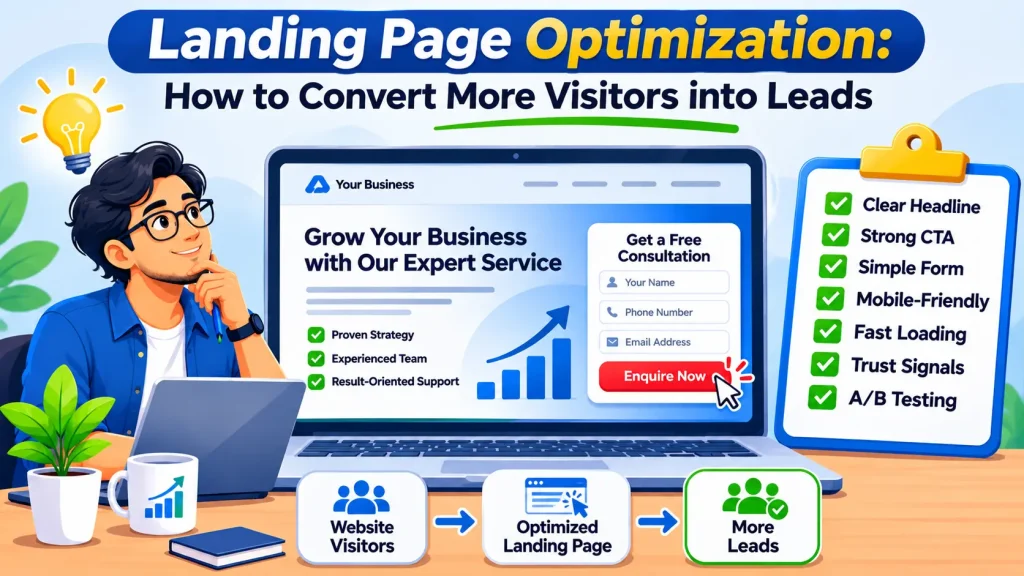
1. Write a Clear and Compelling Headline
Your headline is one of the first things visitors notice.
It should quickly communicate what you offer and why the visitor should care.
Avoid vague headlines such as:
“Welcome to Our Website”
Instead, use a specific headline that communicates the value of your offer.
For example:
“Get Expert Digital Marketing Support to Generate More Business Enquiries”
A strong headline should be:
- Easy to understand
- Relevant to the visitor’s problem
- Connected to the advertisement or search intent
- Focused on a clear benefit
Your visitor should not have to guess what your business does.
2. Create a Strong Call to Action (CTA)
A Call to Action tells visitors what to do next.
Examples include:
- Get a Free Consultation
- Request a Quote
- Book Your Appointment
- Enquire Now
- Download the Free Guide
- Call Us Today
Use action-oriented language and make your CTA button visually noticeable.
Avoid using several competing CTA messages in the same section. If your primary goal is to generate enquiries, make that action the most prominent.
You can repeat the same CTA at relevant points on a longer page, but keep the action consistent.
3. Match Your Landing Page with Your Advertisement
Message consistency is essential.
Suppose your Facebook Ad promotes website design services for small businesses. When visitors click the ad, they should land on a page that clearly explains your website design service.
They should not have to search through unrelated services or general company information.
Make sure the following elements match:
- Advertisement headline
- Advertisement offer
- Landing page headline
- Main page content
- Call to action
This alignment helps visitors understand that they have reached the right destination.
4. Focus on One Primary Conversion Goal
A landing page should have a clear purpose.
If you want visitors to submit an enquiry form, avoid distracting them with too many unrelated options.
For example, a lead generation page may include:
- A clear headline
- A short explanation of the service
- Key benefits
- Relevant proof or testimonials
- An enquiry form
- A prominent CTA
This does not mean every landing page must have only one link. It means the page should guide visitors towards one primary action rather than competing goals.
5. Keep Your Lead Generation Form Simple
Long forms can create unnecessary friction.
Only ask for information that you genuinely need at the initial enquiry stage.
For example, a basic service enquiry form might request:
- Name
- Phone number
- Email address
- Service required
If you need additional information to qualify leads, consider asking those questions after the initial enquiry or using a carefully designed multi-step form.
Also, make sure that:
- Field labels are clear.
- Required fields are identified.
- Error messages explain how to fix a problem.
- The submit button is easy to find.
- A confirmation message appears after successful submission.
Never assume that a form is working just because it looks correct. Submit a test enquiry and verify that the information reaches the correct email address, CRM, or lead management system.
6. Make Your Landing Page Mobile-Friendly
Many visitors will access your website from smartphones.
A page that looks good on a desktop may be difficult to use on a smaller screen.
Check that:
- Text is readable without zooming.
- Buttons are easy to tap.
- Forms fit the screen properly.
- Images resize correctly.
- Important information appears near the top.
- There is no unwanted horizontal scrolling.
- Phone and WhatsApp contact options work correctly.
Test the page on actual mobile devices, not only through the desktop preview in your website builder.
7. Improve Page Loading Speed
Visitors may leave if your page takes too long to load.
Common causes of slow landing pages include:
- Large, uncompressed images
- Unnecessary plugins
- Excessive animations
- Too many scripts and tracking tools
- Poor hosting performance
- Unoptimized page builder elements
You can use Google PageSpeed Insights to assess page performance and identify possible improvements.
Also monitor Google’s Core Web Vitals:
- Largest Contentful Paint (LCP) measures loading performance. Aim for 2.5 seconds or less.
- Interaction to Next Paint (INP) measures responsiveness. Aim for 200 milliseconds or less.
- Cumulative Layout Shift (CLS) measures visual stability. Aim for a score of 0.1 or less.
These are Google’s recommended thresholds for a good user experience, not a guarantee of higher rankings or more leads.
You can read the official Google Core Web Vitals documentation for more details.
8. Add Genuine Testimonials and Trust Signals
Visitors often want evidence that your business is reliable before contacting you.
You can build confidence by displaying genuine trust signals such as:
- Real customer testimonials
- Verified reviews
- Relevant case studies
- Business address and contact details
- Professional certifications, where applicable
- Clear service descriptions
- Transparent pricing or quotation information
Do not publish fabricated reviews, fake client logos, or unsupported performance claims.
If you are a new business without testimonials, focus on explaining your process, showing relevant work samples, and making your contact information easy to verify.
9. Use Relevant Images and Videos
Visual elements can help visitors understand your product or service.
For example:
- A coaching centre can show its classrooms, faculty, and learning environment.
- A software company can display product screenshots.
- A digital marketing agency can show examples of its work.
- A real estate business can display property images and walkthrough videos.
Use visuals that support your message rather than adding images simply to fill empty space.
Optimize image file sizes and use descriptive alternative text where appropriate.
10. Make Your Offer Valuable and Specific
Visitors need a clear reason to take action.
A generic message such as “Contact Us for More Information” may not communicate enough value.
Depending on your business, you could offer:
- A free initial consultation
- A detailed quotation
- A product demonstration
- A course counselling session
- A downloadable guide
- A service assessment
Make sure the offer is genuine and clearly explain what the visitor will receive.
Avoid promising guaranteed results unless you can genuinely support and honour that promise.
11. Reduce Unnecessary Distractions
A landing page should help visitors focus on the offer.
Too many pop-ups, animations, banners, menu links, and unrelated sections can interrupt the decision-making process.
Review every element and ask:
“Does this help the visitor understand the offer, build trust, or take action?”
If an element does not support the main goal, consider removing or simplifying it.
For a campaign-specific landing page, a simplified navigation menu may help visitors stay focused. However, do not hide essential business information or make it difficult for people to contact you.
12. Test and Improve Your Landing Page Regularly
Landing page optimization is not a one-time task.
You should review performance and test changes based on actual visitor behaviour.
You can test elements such as:
- Headline wording
- CTA button text
- Form length
- Image selection
- Page layout
- Offer presentation
- Trust signal placement
Change one major element at a time when possible. This makes it easier to understand which change may have influenced the result.
For a meaningful A/B test, divide traffic between the original page and the alternative version, then compare the results. Avoid making a decision from a very small number of visitors or leads.
How to Measure Landing Page Performance
You cannot improve a landing page effectively if you do not measure its performance.
Track the following metrics:
1. Conversion Rate
Conversion rate is the percentage of visitors who complete your desired action.
Formula:
Conversion Rate = (Total Conversions ÷ Total Visitors) × 100
For example, if 1,000 visitors generate 40 form submissions:
Conversion Rate = (40 ÷ 1,000) × 100 = 4%
This is only an example, not a recommended benchmark. The right conversion rate depends on your industry, traffic quality, offer, and conversion goal.
2. Number of Leads
Track how many enquiries your landing page generates during a specific period.
Separate genuine leads from spam submissions and duplicate enquiries where possible.
3. Cost Per Lead (CPL)
If you are running paid advertising, calculate how much you spend to generate each lead.
Formula:
Cost Per Lead = Total Advertising Spend ÷ Number of Leads
For example, if you spend ₹5,000 and generate 25 leads, your cost per lead is ₹200.
However, a low cost per lead does not automatically mean a successful campaign. You should also evaluate lead quality and actual sales outcomes.
4. Lead Quality
Measure whether the enquiries are relevant to your business.
Consider:
- How many leads match your target audience?
- How many respond to follow-up calls?
- How many are genuinely interested?
- How many become paying customers?
A landing page that generates fewer but more relevant enquiries may be more valuable than one that generates many low-quality leads.
5. Form Abandonment
Check whether visitors start filling out your form but leave before submitting it.
If many users abandon the form, investigate its length, usability, error messages, loading behaviour, and mobile experience.
Landing Page Optimization for Different Businesses
The best landing page structure depends on what you sell and what action you want visitors to take.
Here are a few examples.
Coaching Centres
A coaching centre landing page can include:
- Course name and target students
- Subjects and class levels
- Faculty information
- Teaching approach
- Genuine student or parent reviews
- Class location and contact details
- Admission enquiry form
Primary CTA: “Enquire About Admission”
Digital Marketing Agencies
A digital marketing agency landing page can include:
- Services offered
- Types of businesses served
- Explanation of the marketing process
- Relevant work samples or case studies
- Clear service enquiry form
- Contact information
Primary CTA: “Book a Consultation”
Local Service Businesses
A local service business can highlight:
- Services and service areas
- Key benefits
- Real project images
- Customer reviews
- Phone and WhatsApp contact options
- Enquiry form
Primary CTA: “Request a Quote”
The important principle is to make the page relevant to the visitor’s needs and the action you want them to take.
Common Landing Page Optimization Mistakes to Avoid
Even a professionally designed landing page can perform poorly if it contains basic usability or messaging problems.
Avoid these common mistakes:
- Unclear headlines: Visitors cannot quickly understand what you offer.
- Weak CTA: The next step is not obvious.
- Too many form fields: Visitors are asked for unnecessary information.
- Poor mobile design: Buttons, text, or forms are difficult to use on smartphones.
- Slow loading: Large images and unnecessary scripts affect performance.
- No trust signals: Visitors cannot find genuine evidence of credibility.
- Ad and page mismatch: The landing page does not deliver what the advertisement promised.
- No conversion tracking: You cannot reliably measure form submissions or other important actions.
- Fake or exaggerated claims: Unsupported promises damage credibility.
- No regular testing: The page is left unchanged even when performance is poor.
Read More: Google Ads Conversion Tracking: Complete Setup Guide
Landing Page Optimization Checklist
Before publishing or running advertisements to a landing page, review this checklist:
- The headline clearly explains the offer.
- The page matches the advertisement or traffic source.
- The primary CTA is visible and understandable.
- The page has one clear primary conversion goal.
- The form asks only for necessary information.
- Form submissions are tested successfully.
- The page works properly on mobile devices.
- Images are optimized.
- Loading performance has been checked.
- Genuine testimonials or trust signals are included where available.
- Contact details are accurate and easy to find.
- Conversion tracking is configured and tested.
- Privacy information is available where personal data is collected.
- The page has been reviewed for unnecessary distractions.
Frequently Asked Questions (FAQs)
1. What is landing page optimization?
Landing page optimization is the process of improving a webpage’s content, design, layout, speed, and user experience to increase the percentage of visitors who complete a desired action, such as submitting a form or making an enquiry.
2. Why is landing page optimization important?
It helps businesses make better use of existing website traffic, improve the visitor experience, build trust, and potentially generate more relevant leads without relying only on increasing advertising spend.
3. What makes a landing page convert better?
A clear headline, relevant offer, strong CTA, simple form, mobile-friendly design, fast loading, and genuine trust signals can all contribute to better conversion performance. Results depend on the audience and offer.
4. How many CTAs should a landing page have?
A landing page should have one primary conversion goal. You can repeat the same CTA in different sections, but avoid presenting several unrelated actions that compete for attention.
5. How do I increase landing page conversion rates?
Start by checking your traffic quality, headline, offer, CTA, form, mobile usability, page speed, and trust signals. Use analytics and controlled tests to identify which changes improve results.
6. Is landing page optimization important for Google Ads?
Yes. A landing page should be relevant to the advertisement and keywords, provide useful information, and make the desired action easy to complete. Landing page experience is one of the factors associated with Google Ads Quality Score.
7. How do I track landing page conversions?
You can use Google Analytics 4, Google Tag Manager, and advertising platform conversion tracking to measure actions such as form submissions, calls, and purchases. Make sure tracking is configured correctly and test it before relying on the data.
8. How often should I optimize my landing page?
Review performance regularly and make changes when data indicates a problem or opportunity. The right testing frequency depends on how much relevant traffic and conversion data your page receives.
Conclusion
Landing Page Optimization is an important part of turning website visitors into potential customers.
Driving traffic through Google Ads, Meta Ads, SEO, or social media is not enough if visitors cannot understand your offer or complete the next step.
Start with the basics: write a clear headline, create a relevant offer, use a strong CTA, simplify your form, improve mobile usability, and build trust with genuine information. Then measure conversions and test improvements based on actual data.
Remember, the goal is not simply to make your landing page look attractive. The goal is to make it useful, relevant, trustworthy, and easy to take action.
If your website receives visitors but generates fewer enquiries than expected, it may be time to review your landing page strategy.
Need help improving your website or generating more business enquiries? Explore SouravLabs to learn how a better website experience and digital marketing strategy can support your business growth.